Audio Phase & Polarity Explained

Audio Phase & Polarity Explained for Beginners – episode 7 of BIGZUN Modular Academy, a free step-by-step video course about sound, synthesis and modular synthesizers. Made for beginners, no experience needed.
Welcome to Bigzun Modular Academy, for beginners. Combining sounds can make them stronger, weaker, or even silent. Today, we will discover why phase and polarity matter. For a repeating wave, phase describes position within a cycle. One full cycle is three hundred sixty degrees. A half cycle is one hundred eighty degrees.
Chapters
- Phase & Polarity
- Phase is position within a cycle
- Matching waves reinforce each other
- Polarity inversion flips the signal
- Perfect opposition can cancel
- Real cancellation may be incomplete
- Delay shifts different frequencies differently
- A short delay can create comb filtering
- Check stereo sounds in mono
- Invert with BIGZUN Dual Attenuverter
- Try it: compare before and after summing
- Phase and polarity are related, not identical
Lesson notes
Phase & Polarity
Welcome to BIGZUN Modular Academy, for beginners. Combining sounds can make them stronger, weaker, or even silent. Today, we will discover why phase and polarity matter.
Phase is position within a cycle
For a repeating wave, phase describes position within a cycle. One full cycle is three hundred sixty degrees. A half cycle is one hundred eighty degrees.
Matching waves reinforce each other
Two identical waves in phase add together. With equal input levels, their summed amplitude doubles. Keep headroom available when combining signals, because the resulting peaks can be larger.
Polarity inversion flips the signal
Polarity inversion flips every positive value negative and every negative value positive. For a sine, this also looks like a half-cycle shift. For complex sounds, inversion and delay are different operations.
Perfect opposition can cancel
Mix identical signals at equal levels with opposite polarity, and they cancel. In this ideal demonstration, the first pair reinforces and the second becomes silent. That silence is intentional.
Real cancellation may be incomplete
If the levels differ, cancellation is incomplete. If the waveforms differ, some components may remain. Perfect silence requires matching signals and matching levels, with opposite polarity.
Delay shifts different frequencies differently
A time delay creates a frequency-dependent phase shift. The same delay can put one frequency in opposition and another back in alignment. A polarity switch does not do that.
A short delay can create comb filtering
Combine a sound with a slightly delayed copy. Some frequencies reinforce while others cancel, producing a comb-shaped response. Listen to noise before and after this short-delay combination.
Check stereo sounds in mono
A wide stereo sound may change when its channels are combined into mono. Check the result while building a patch. A sound that seems spacious can become weaker in a mono mix.
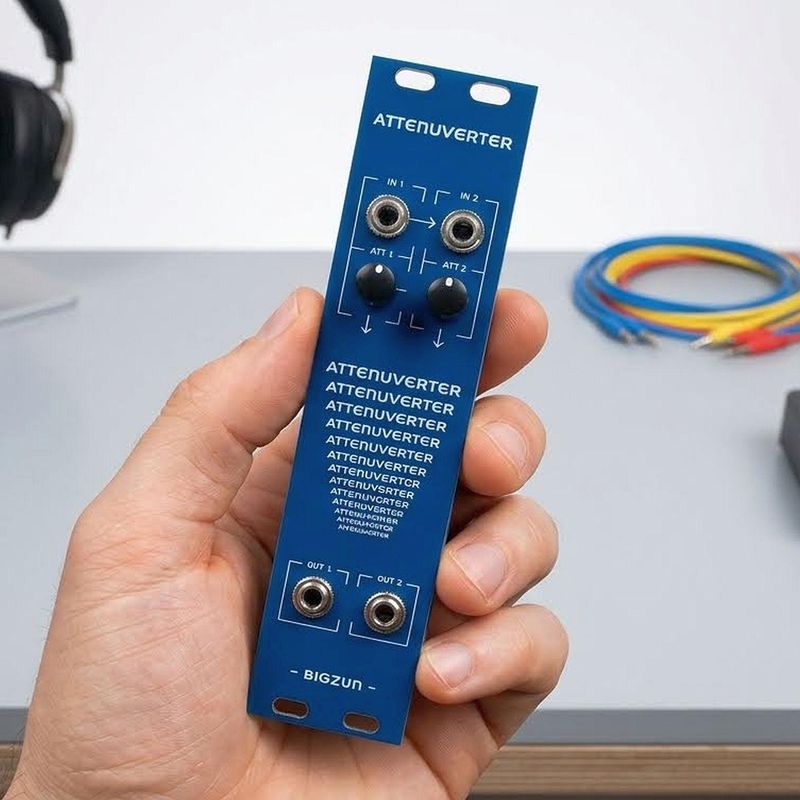
Invert with BIGZUN Dual Attenuverter
The BIGZUN Dual Attenuverter can change signal depth and polarity. With offset set to zero, negative gain produces an inverted version. Use a proper mixer to compare signals.
Try it: compare before and after summing
Compare one quiet signal with a mixture of two copies. Change the polarity and level of one copy. Listen to the sum, and watch how the waveform changes.
Phase and polarity are related, not identical
Remember: phase describes a relationship within cycles, polarity flips values, and delay shifts time. Always listen to the combined result. Next, we shape notes with envelopes.