ADSR Envelopes Explained

ADSR Envelopes Explained for Beginners – episode 8 of BIGZUN Modular Academy, a free step-by-step video course about sound, synthesis and modular synthesizers. Made for beginners, no experience needed.
Welcome to Bigzun Modular Academy, for beginners. An envelope gives a note its shape over time. Today, we explore attack, decay, sustain, and release. An oscillator can run continuously. Route its audio through a voltage controlled amplifier, then use an envelope to control the level. Now each note can have a beginning and an ending.
Chapters
- Envelopes & ADSR
- A continuous tone needs articulation
- Gate and trigger are different
- Attack: the rise to the peak
- Decay: the fall toward sustain
- Sustain is a level, not a time
- Release begins when the gate ends
- AD and ADSR solve different tasks
- One source can become a pluck or a pad
- Envelopes can shape more than volume
- Make simple ramps with BIGZUN GLIDE
- Try it: change one stage at a time
Lesson notes
Envelopes & ADSR
Welcome to BIGZUN Modular Academy, for beginners. An envelope gives a note its shape over time. Today, we explore attack, decay, sustain, and release.
A continuous tone needs articulation
An oscillator can run continuously. Route its audio through a voltage controlled amplifier, then use an envelope to control the level. Now each note can have a beginning and an ending.
Gate and trigger are different
A gate stays high while a note is held. A trigger is a brief event. Different envelope generators respond differently, so check the module behavior rather than assuming every input works alike.
Attack: the rise to the peak
Attack controls how the envelope rises toward its peak. A short attack starts quickly. A longer attack creates a gradual entrance. Listen to the difference using the same source tone.
Decay: the fall toward sustain
Decay controls the transition from the peak toward the sustain level. A short decay can make a note feel plucked or percussive. It is a time parameter.
Sustain is a level, not a time
Sustain sets the level reached after decay, while the gate remains high. It is not the length of the note. A low sustain and high sustain give different held sounds.
Release begins when the gate ends
Release controls how the envelope returns toward its resting level after the gate ends. A short release stops quickly. A longer release lets the sound fade away.
AD and ADSR solve different tasks
An attack-decay envelope is useful for one-shot shapes. An A D S R envelope includes a held sustain stage and a release. The right choice depends on the behavior you need.
One source can become a pluck or a pad
A short contour can turn a sustained oscillator into a pluck. A slower contour can create a swelling pad. Much of the character comes from the envelope, even with the same source.
Envelopes can shape more than volume
An envelope can also change filter cutoff or modulation depth. Here, a simple synthesized tone brightens and darkens as its upper components change over the note.
Make simple ramps with BIGZUN GLIDE
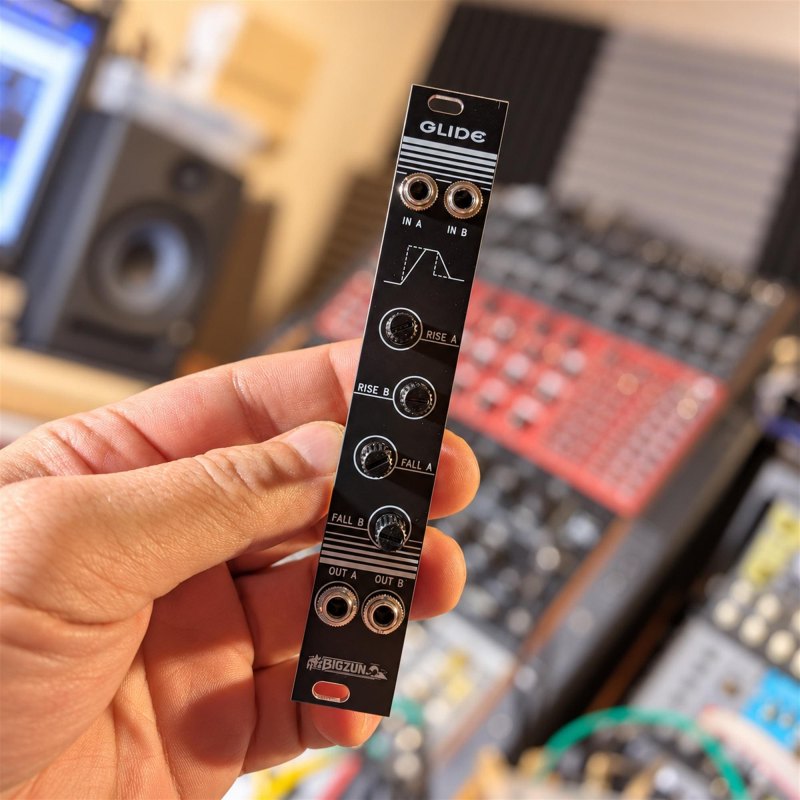
BIGZUN GLIDE is a dual slew limiter with separate rise and fall controls. Feed it a gate to form a simple attack-release contour. This differs from a full A D S R generator.
Try it: change one stage at a time
Change attack, then decay, then sustain, then release. Keep the other settings steady so you can hear each effect. Next, we explore noise and transients.