What Are Harmonics? Sound Design
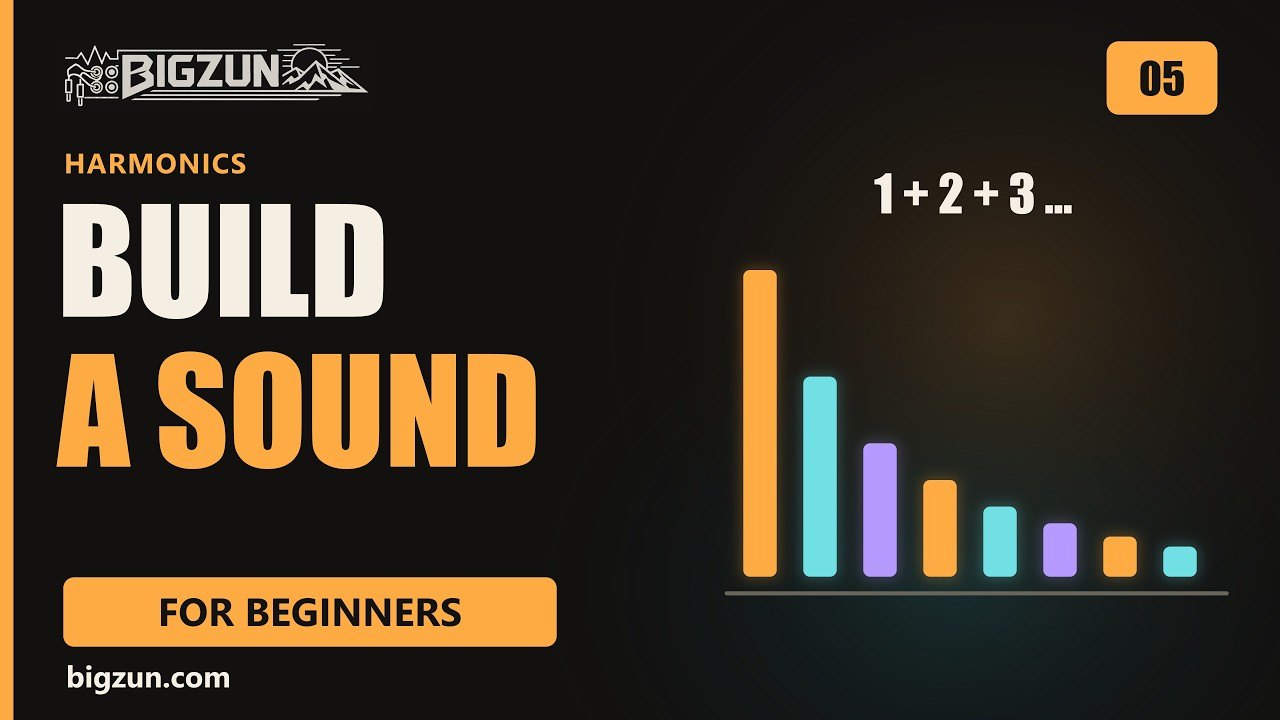
What Are Harmonics? Sound Design for Beginners – episode 5 of BIGZUN Modular Academy, a free step-by-step video course about sound, synthesis and modular synthesizers. Made for beginners, no experience needed.
Welcome to Bigzun Modular Academy, for beginners. Why can two sounds share a note but have different characters? Today, we will build a tone from simpler parts and discover harmonics. The fundamental is the base frequency of a repeating tone. We will start at one hundred ten hertz. A pure sine at this frequency gives us a simple starting point, with no additional harmonics.
Chapters
- Harmonics
- Start with a fundamental
- Harmonics are whole-number multiples
- Add a second and third harmonic
- Square waves favor odd harmonics
- Triangle harmonics fall off faster
- Sawtooth waves use the full series
- Waveform and spectrum tell different stories
- A filter changes harmonic balance
- Not every partial is a harmonic
- Build a small additive patch
- Try it: listen beyond the note
Lesson notes
Harmonics
Welcome to BIGZUN Modular Academy, for beginners. Why can two sounds share a note but have different characters? Today, we will build a tone from simpler parts and discover harmonics.
Start with a fundamental
The fundamental is the base frequency of a repeating tone. We will start at one hundred ten hertz. A pure sine at this frequency gives us a simple starting point, with no additional harmonics.
Harmonics are whole-number multiples
Harmonics occur at whole number multiples of the fundamental. With a fundamental of one hundred ten hertz, the next harmonics are two hundred twenty, three hundred thirty, and four hundred forty. The fundamental is also called the first harmonic.
Add a second and third harmonic
Add a quieter sine at twice the fundamental, then another at three times. The combined waveform becomes more complex. Listen as the extra harmonics change the tone color while the fundamental remains one hundred ten hertz.
Square waves favor odd harmonics
An ideal, centered square wave contains odd harmonics. The third, fifth, and seventh contribute to its characteristic sound. Listen to a sine, then a square with the same fundamental. The added components create a different character.
Triangle harmonics fall off faster
A triangle also has odd harmonics, but its upper components become weaker more quickly than those of a square. That is why a triangle often sounds gentler. The harmonic amplitudes and their phases determine the exact waveform.
Sawtooth waves use the full series
An ideal sawtooth contains both even and odd harmonics. Higher components gradually decrease in amplitude. This broad series gives it a bright sound. Compare it with the smoother triangle at the same fundamental.
Waveform and spectrum tell different stories
A waveform shows the signal changing over time. A spectrum shows how much of each frequency is present. A spectrum is useful for finding a fundamental and its harmonics. The two views describe the same signal in different ways.
A filter changes harmonic balance
A low pass filter can reduce upper harmonics while leaving the fundamental prominent. The sound becomes darker as these components fade. Listen to a bright sawtooth and a filtered version. Their basic note remains the same.
Not every partial is a harmonic
A partial is any individual frequency component. Harmonic partials follow whole number multiples. Other sounds, such as bells, can contain inharmonic partials. These do not fit the same simple pattern and can create metallic characters.
Build a small additive patch
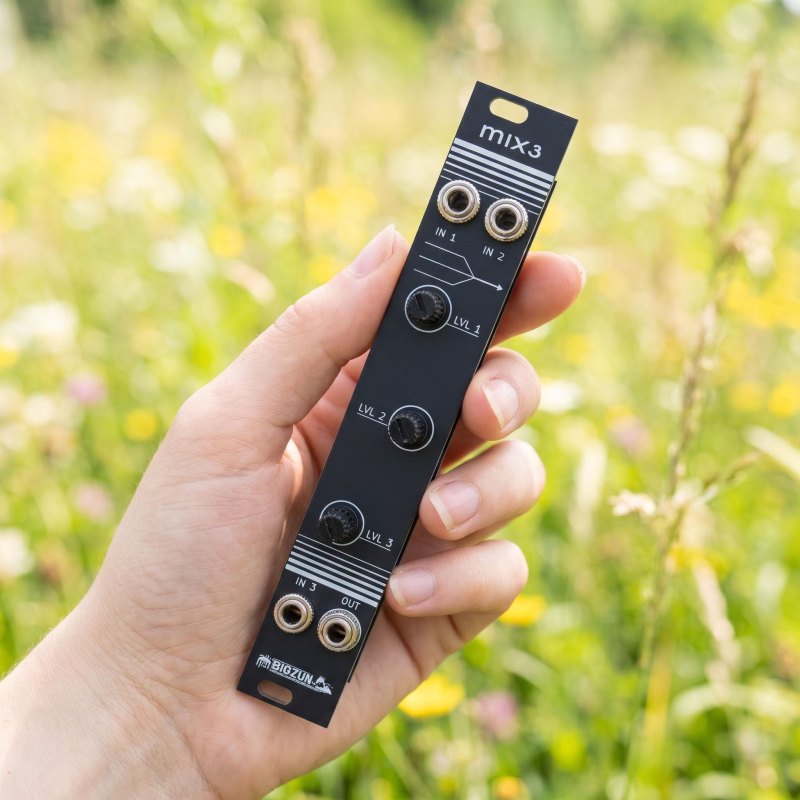
Tune three sine sources to one hundred ten, two hundred twenty, and three hundred thirty hertz. Feed them to the BIGZUN MIX three, and adjust their levels. This illustrates additive synthesis: combining simple components to build a more complex tone.
Try it: listen beyond the note
Compare a sine and a richer waveform at a similar level. Listen for the shared note and the extra brightness. Remember: the fundamental sets our reference, harmonics are its whole number multiples, and their balance shapes timbre. Continue at bigzun.com.