Amplitude vs Loudness: Audio Levels
Amplitude vs Loudness: Audio Levels for Beginners – episode 3 of BIGZUN Modular Academy, a free step-by-step video course about sound, synthesis and modular synthesizers. Made for beginners, no experience needed.
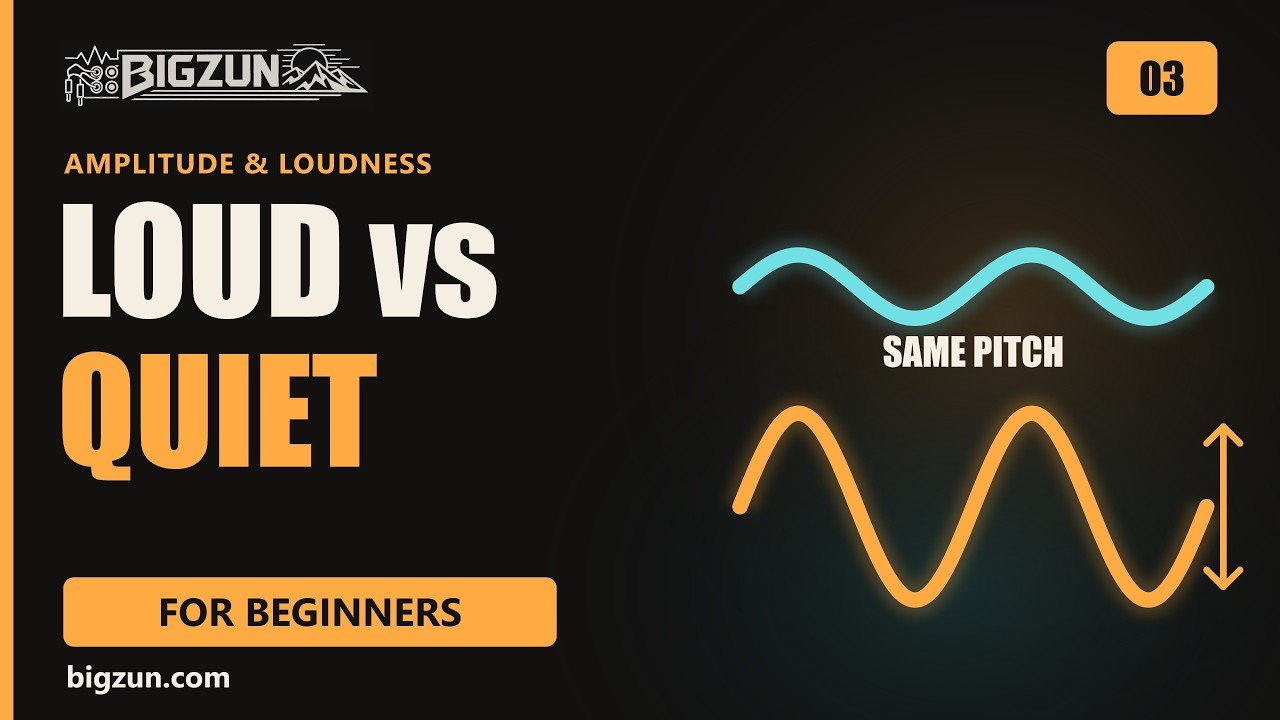
Welcome to Bigzun Modular Academy, for beginners. Today we explore amplitude, loudness, and level. You will hear how one tone changes when we change its size. Amplitude describes the size of a vibration or an electrical signal. On this graph, a taller wave has a greater amplitude. The horizontal spacing is unchanged, so the frequency stays the same.
Chapters
- Amplitude & Loudness
- Amplitude is the size of a signal
- Positive and negative are directions
- Same pitch, three different levels
- Peak and average are different
- Gain changes the signal level
- What does a decibel tell us?
- Leave headroom to avoid clipping
- An envelope changes level over time
- A VCA makes level controllable
- Control a level with BIGZUN ATT2
- Try it: change level, keep the pitch
Lesson notes
Amplitude & Loudness
Welcome to BIGZUN Modular Academy, for beginners. Today we explore amplitude, loudness, and level. You will hear how one tone changes when we change its size.
Amplitude is the size of a signal
Amplitude describes the size of a vibration or an electrical signal. On this graph, a taller wave has a greater amplitude. The horizontal spacing is unchanged, so the frequency stays the same.
Positive and negative are directions
An audio signal often swings above and below its center line. Negative voltage is not negative loudness. Both halves are part of the vibration. We measure the size relative to the center.
Same pitch, three different levels
Listen to one sine wave at three levels. The frequency stays at two hundred twenty hertz. Only its amplitude changes. Start with a comfortable listening volume, and keep that setting during the comparison.
Peak and average are different
Peak level describes the largest excursion of a signal. An average measure describes its behavior over time. R M S is one useful average measure. Two waveforms with the same peak can have different average levels.
Gain changes the signal level
Gain is a multiplier. A gain of one leaves the level unchanged. A gain of one half reduces the amplitude. A gain of two doubles it. Always leave room for the resulting signal.
What does a decibel tell us?
For the same signal and conditions, doubling voltage amplitude is approximately plus six decibels. Halving it is approximately minus six. This does not mean that the sound will seem twice as loud to you.
Leave headroom to avoid clipping
Headroom is room for signal peaks. Push beyond a system limit, and the waveform may clip. The flattened peaks add distortion. Listen to a clean tone and a clipped version, with their playback levels kept similar.
An envelope changes level over time
Amplitude can change during a note. A fast attack creates a clear beginning. A slower attack fades in. The envelope shapes this change. Compare a short pluck with a slower, swelling note.
A VCA makes level controllable
A voltage controlled amplifier, or V C A, lets another signal control the level. An envelope can shape each note. A slow oscillator can create tremolo: changing loudness while the pitch stays steady.
Control a level with BIGZUN ATT2
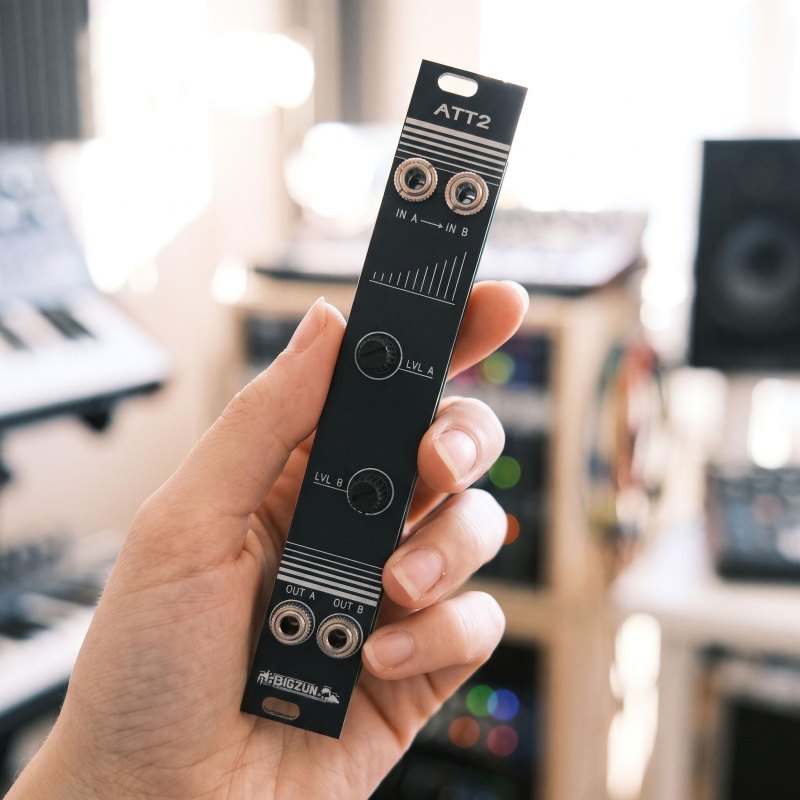
The BIGZUN A T T two has two passive attenuator channels. Each knob reduces a signal from its full input level toward zero. It can adjust audio level or reduce the depth of a control signal.
Try it: change level, keep the pitch
Try a sustained note and gently lower its level. The pitch should stay steady. Remember: amplitude is signal size, loudness is your perception, and headroom helps prevent clipping. Next, we explore waveforms. Continue at bigzun.com.