Frequency vs Pitch: Hertz & Octaves
Frequency vs Pitch: Hertz & Octaves for Beginners – episode 2 of BIGZUN Modular Academy, a free step-by-step video course about sound, synthesis and modular synthesizers. Made for beginners, no experience needed.
Welcome to Bigzun Modular Academy, for beginners. Today, let's discover why one tone sounds low and another sounds high. The key is frequency. A cycle is one complete repeat of a vibration. Follow the moving dot. It starts at the center, goes through a peak and a trough, then returns to the same position and direction.
Chapters
- Frequency & Pitch
- What is one cycle?
- Hertz means cycles per second
- Frequency and period
- From separate pulses to a tone
- Frequency changes pitch
- Double the frequency: one octave up
- Halve the frequency: one octave down
- Pitch is not the whole sound
- Pitch and volume are different
- Check a tone with a tuner
- Try it: sing an octave
Lesson notes
Frequency & Pitch
Welcome to BIGZUN Modular Academy, for beginners. Today, let's discover why one tone sounds low and another sounds high. The key is frequency.
What is one cycle?
A cycle is one complete repeat of a vibration. Follow the moving dot. It starts at the center, goes through a peak and a trough, then returns to the same position and direction.
Hertz means cycles per second
Frequency counts the cycles in one second. The unit is hertz, written H Z. Four complete cycles in one second means four hertz. This slow example makes the counting easy to see.
Frequency and period
The period is the time needed for one cycle. At two hertz, each cycle takes half a second. At four hertz, each cycle takes a quarter of a second. Higher frequency means a shorter period.
From separate pulses to a tone
Very slow pulses sound like separate events. Speed up the repetition, and the events begin to merge into a tone. Listen to this short demonstration. Keep your listening volume comfortable.
Frequency changes pitch
For a simple repeating tone, higher frequency gives a higher pitch. Compare two sine waves. The second vibrates twice as fast as the first. Their amplitudes are the same.
Double the frequency: one octave up
Doubling the frequency raises a tone by one octave. Listen to one hundred ten, two hundred twenty, four hundred forty, and eight hundred eighty hertz. Each step goes up by the same musical interval.
Halve the frequency: one octave down
The relationship works in reverse. Halve the frequency, and you move down one octave. The change from eight hundred eighty to four hundred forty hertz is the same interval as four hundred forty to two hundred twenty.
Pitch is not the whole sound
A sine wave and a sawtooth can share the same fundamental frequency. The sawtooth contains additional harmonics, so its tone color is different. Listen for a similar pitch, but a brighter sound.
Pitch and volume are different
Changing amplitude changes the level of the signal. It does not change its frequency. Listen to the same sine wave, first softer and then louder. The pitch stays the same.
Check a tone with a tuner
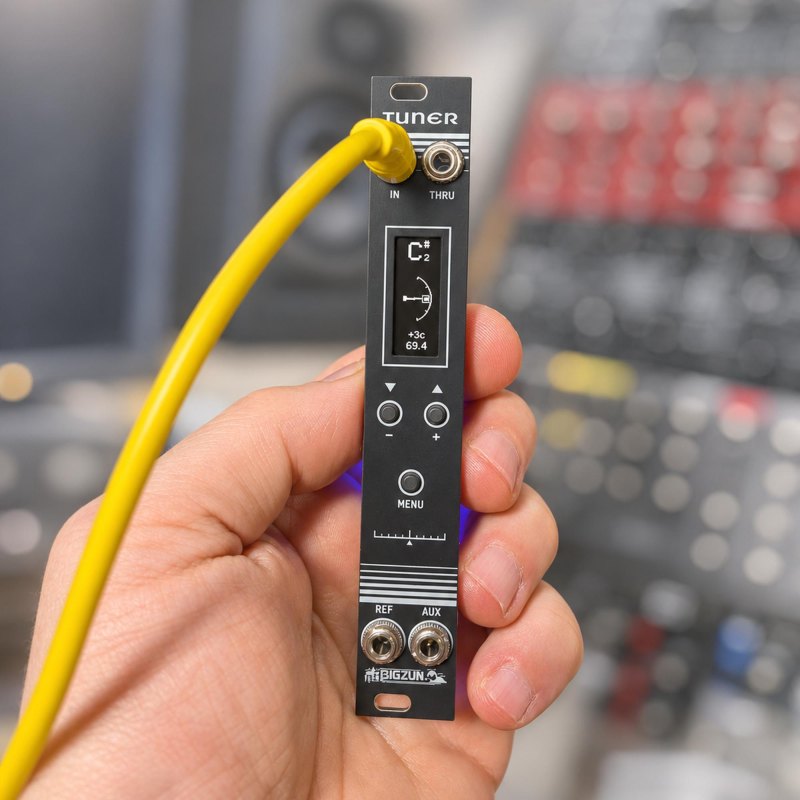
A tuner helps you measure pitch. The BIGZUN TUNER displays note, octave, cents, and frequency. A common reference is A four at four hundred forty hertz. Adjust the oscillator slowly and watch the measurement approach the target.
Try it: sing an octave
Try humming a comfortable note, then gently hum higher. Can you find the same note name one octave above? Remember: double the frequency, one octave up. Next, we explore amplitude and loudness. Continue at bigzun.com.